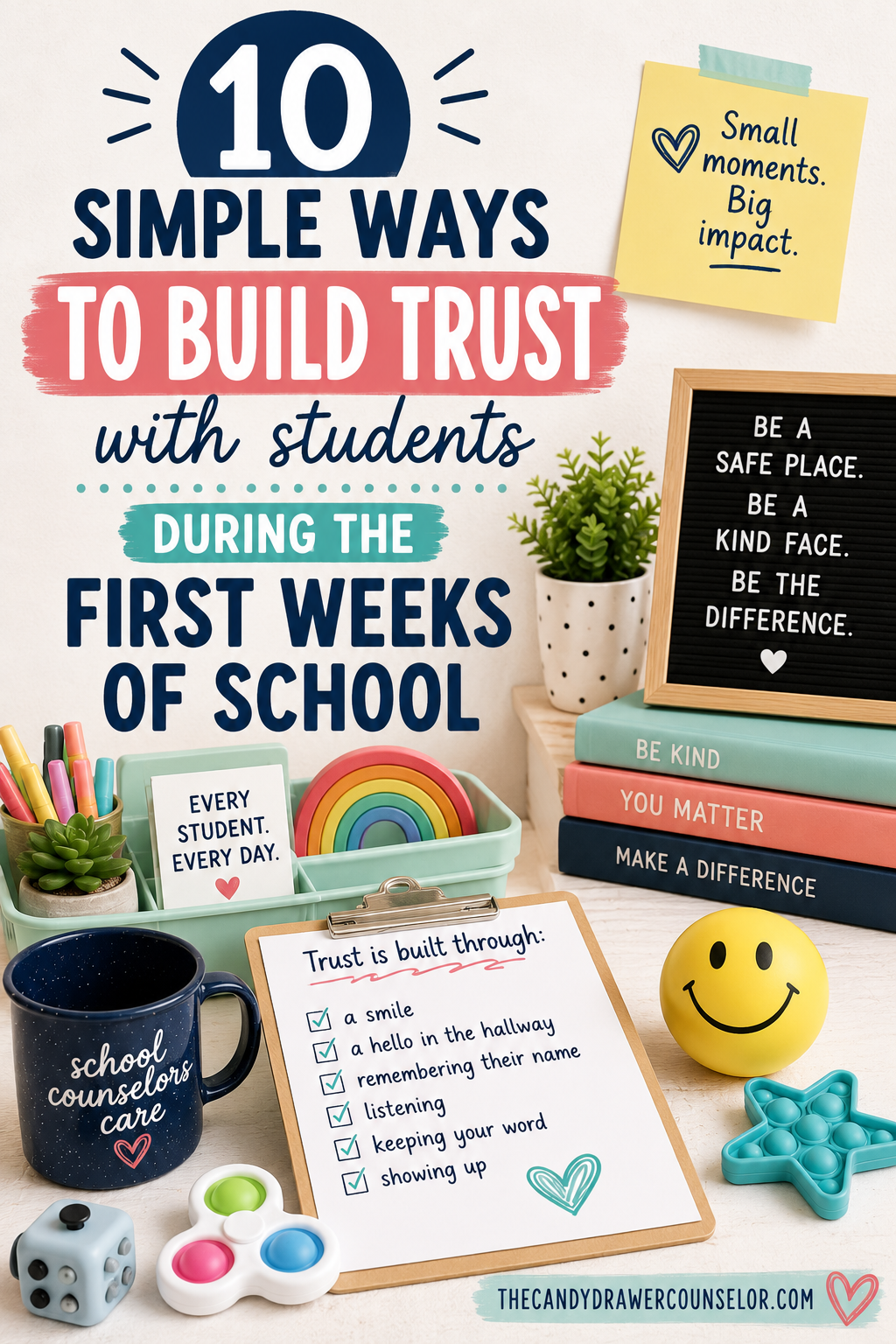
The beginning of a new school year comes with a lot.
New schedules.
New students.
Classroom lessons.
Parent emails.
Teachers stopping by with, “Do you have a minute?”
And approximately 47 things you meant to get done before the first bell rang.
It’s easy to feel like you need to have everything perfectly organized before students walk through the doors.
But there’s something much more important than having the perfect counseling office or the perfect first lesson:
Do students feel like they can trust you?
Trust isn’t something we can teach in one classroom lesson or build during one counseling session. It happens slowly through the little things we do every day.
Here are 10 simple ways to start building that trust from the beginning.
1. Be Where Students Are
Don’t wait for students to find your office.
Stand in the hallway.
Visit the cafeteria.
Walk through recess.
Say hello at arrival.
Those quick interactions give students a chance to know you without the pressure of sitting across from you in your office.
Sometimes a hallway wave is where the relationship starts.
2. Learn Their Names
There is something powerful about hearing an adult say your name.
You won’t remember hundreds of names immediately—and students don’t expect you to.
But keep trying.
When you finally say, “Hey, Jordan!” instead of just, “Hey, buddy,” they notice.
Remembering a name says:
I see you.
3. Let Them Look Around Your Office
Students notice your office before they notice almost anything else.
They’ll look at the fidgets.
The books.
The posters.
And yes…
the candy drawer. 🍬
Let them explore a little.
Sometimes picking up a fidget or looking through a book gives a nervous student something to focus on while they decide whether they’re ready to talk.
4. Don’t Start With “What’s Wrong?”
Imagine meeting someone and immediately being asked to explain your biggest problem.
That’s a lot.
Start smaller.
“How’s your day going?”
“What class did you just come from?”
“Tell me about that sticker on your water bottle.”
Conversation can build the bridge to the harder stuff.
5. Remember Something They Told You
If a student tells you they have a soccer game Friday, ask about it Monday.
If they tell you their dog is sick, remember.
If they’re nervous about a test, check in afterward.
You don’t have to remember everything.
But remembering one small detail can communicate something big:
What you tell me matters.
6. Don’t Rush the Silence
Some students walk into the counseling office and immediately tell you everything.
Others sit down and say:
“I don’t know.”
That’s okay.
You don’t have to fill every second with questions.
Let them play with a fidget.
Let them look around.
Let the room be quiet.
Sometimes students need to know you’re comfortable with their silence before they’ll trust you with their words.
7. Follow Through
If you tell a student you’ll check on something, check on it.
If you say you’ll see them tomorrow, try to see them tomorrow.
Students notice when adults follow through.
You won’t always be able to fix the problem.
But you can show them that your words mean something.
8. Notice Them Outside Your Office
One of my favorite trust-building moments doesn’t happen during counseling at all.
It’s seeing a student in the hallway and saying:
“Hey! Good to see you.”
That’s it.
No counseling.
No questions.
No problem to solve.
You’re simply letting them know:
I notice you even when you don’t need something from me.
9. Let Them Come for the Candy Sometimes
The student who says,
“I’m just here for candy,”
might actually be there for candy.
And that’s okay.
But they might also be checking to see who’s in your office.
Whether you’re busy.
Whether you’re happy to see them.
Whether today feels like a good day to tell you something.
The candy isn’t magic.
It’s an invitation.
Sometimes that tiny reason to walk through your door is exactly what a student needs.
10. Be Consistent
You don’t need a Pinterest-perfect office.
You don’t need the perfect counseling lesson.
You don’t need to say exactly the right thing every time.
Students need to know what they’re going to get when they come to you.
A calm adult.
A welcoming space.
Someone who listens.
Someone who remembers.
Someone who keeps showing up.
Because trust isn’t built through one amazing conversation.
It’s built through hundreds of ordinary ones.
You Don’t Have to Build Trust All at Once
At the beginning of the year, we can put so much pressure on ourselves to connect with every student immediately.
But relationships don’t work that way.
You don’t need every student to walk into your office during the first week and tell you their life story.
Start with the smile.
Learn the name.
Wave in the hallway.
Remember the soccer game.
Let them grab the candy.
Give them time.
Those little moments are doing more than you think.
Because one day, a student may have something big they need to tell someone.
And because of all those small moments that came before it, they’ll already know where to go.
Trust isn’t built in one conversation. It’s built in hundreds of small moments.
Leave a Reply